Posts

Micromanaging and Moksha

Image
Nicolas Leonard Sadi Carnot was not known as a yoga teacher, though his scientific work has great application for those of us interested in Moksha (yogic liberation). Carnot was a French physicist who laid the theoretical groundwork that led to the development of the internal combustion engine. Whether you loathe or love this particular technology, Carnot's work was the start of a long line of innovation that led to harnessing the Motive Power of Fire . Having developed the thermodynamic principles (now known as the Carnot Cycle) that made internal combustion engines possible, Carnot also described what is now known as the Second Law of Thermodynamics. Understanding the conceptual framework of the Second Law of Thermodynamics can be liberating for students of yoga. There are many ways we can express the 2nd law, as its wisdom has proven useful across many branches of science. In essence, the 2nd law tells us that an ordered system is very difficult to maintain. As time goes on, it ...

Triangle Pose and your SI joints

Image
The other day I was reading an article about yoga injuries. When you're a full-time yoga teacher, the subject of yoga-injuries is a pretty disheartening matter. I imagine an auto mechanic feels similarly when a wheel falls off during a test-drive (ahem, not that I know anything about that particular example!). The article, titled Understanding and Preventing Yoga Injuries , appeared in the 2009 International Journal of Yoga Therapy . While yoga remains a safe and effective path, the article underscored the need for yoga teachers to better understand the mechanics of the body. I was watching a colleague teaching Utthita Trikonasana , commonly known as Triangle Pose. It is virtually ubiquitous in most yoga classes; and while it has the potential to open the hips and free up the spine, it also has the potential to strain the sacroiliac (SI) joints. Given how many millions of Triangle poses are likely taught each day, a deeper understanding of pelvic anatomy could help many people live...

Autumn at the BMDC

Image
The equinox marked the official start of autumn, and our recent spate of cool weather underscores this astronomical observation. We've had our fair share of frost-on-the-pumpkin days, and what wasn't harvested already is next season's compost-able material. After a string of cool and rainy days, a sunny day in the 50's is shorts and T-shirt weather. It's also the time to get the windows washed and the screens put away. Such are the rituals of the Midwest. Have a great fall, and for those living in Northern climates, don't forget to drain your outdoor spigots, put away the screens and make sure there's no debris around to clog the inlet of the snow-blower. From all of us here at the Blue Mounds Dharma Center, Happy autumn! ~ Scott www.alignmentyoga.com

Balance and the Senses

Image
While the majority of creatures occupy a more horizontal place in this world, we human beings occupy a uniquely vertical niche. We exist within a tiny operating window in the vertical plane, which requires both functional hardware and operable software. In practicing yoga, we often focus on the hardware - are the muscles sufficiently toned? are the muscles flexible? do the joints have full mobility within the healthy range of the musculature? While functional hardware is essential to optimal health, it’s only a portion of the equation. Without coherent software, our motions are disjointed and inefficient. The software of the human being is the interface of body and mind - clearly within the jurisdiction of a healthy yoga practice. It’s not sufficient to ask whether or not we can make any particular movement, optimal efficiency asks how we make the movement; and for each one there are generally several ways to accomplish the desired movement. There’s the most efficient way, and then ...

Cultivating a Supple Spine

Image

Uncharted Territory

Image
This fall we’re entering uncharted territory. While that’s true for each and every day, we’ve largely shielded ourselves from this reality with the safety and security of our routine. Every so often, a hurricane, earthquake or tornado interrupts our routine, and it’s interesting to see what portions of our old routine is regained, and what sloughs away in the transition. The H1N1 virus is our portal to uncharted territory in the coming months. We have no idea what may transpire – perhaps this is exaggerated like Iraq’s weapons-of-mass-destruction, or we may be looking down the barrel of an epidemic. We have no idea, nor do we have much control. While our public health officials are working diligently to stave off a full-blown epidemic, the tools seem undersized for the task at hand. I’m reminded of a tooth-brushing lesson hosted by my elementary school some 35 years ago. A community dentist came into our school and class-by-class, taught us the proper brushing technique. After an infor...

India Passages

Image
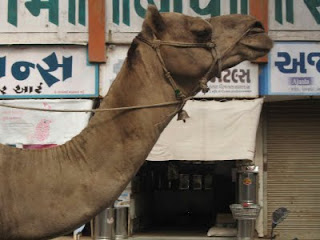
The Boeing 777 infotainment center invited me to any number of diversions. I could play games, watch movies and even shop (duty-free, no less). That all seemed a million miles removed from the apartment in Delhi (Dwarka, Sector 6) where the barriers of geography and language kept us focused on the countdown to our flight to Ahmedabad. Each time I visit India I experience days that seem to stretch out infinitely to the horizon. Generally they’re days spent in a huge city, and usually, language barriers create a feeling of confinement. This trip hewed to the pattern, as our hosts tended to our every need (some real, some imagined) while our furtive attempts at gesticulating our desires (transport to the Lodi Gardens and the Red Fort) brought fresh chapattis to the table. India’s capacity to catalyze growth most assuredly is not confined to the practices of yoga and meditation. After our de facto retreat, the journey to Mahuva began. It had been two years since I’d visited Morari Bapu at ...