Posts

Why Meditation Is Part of My Fitness Regimen

Behavior change is hard. Whether you're trying to be more active, adjust your default workout intensities, or eat more kale, ingrained patterns resist our good intentions. This is among the many reasons meditation is an integral part of my fitness regimen. Without working directly with the mind, behavior change tends to be an arduous and often futile task. Thankfully, the mind is malleable, and meditation is one of the most reliable ways to put that malleability to work. Neuroplasticity is the term for how your brain constantly restructures itself in response to experience. Neuroscientists often summarize Donald Hebb's famous principle this way: neurons that fire together, wire together. Most of the time, this rewiring happens without our noticing. Live under chronic stress, and the brain's stress circuitry grows stronger. Spend years navigating the maze of London's streets, as the city's cab drivers do, and the brain regions associated with spatial memory actually ...

Sleep & Aging

Image
For most of my adult life, I could drink coffee after lunch and sleep just fine. These days a 1pm cup means I'm staring at the ceiling at 1:30am. As we age, our bodies take progressively longer to clear caffeine out of our system . The tolerance you built in your twenties doesn't carry forward. It quietly erodes, and most of us fail to connect the dots between our afternoon espresso and the sleep we can't figure out how to fix. I'm fond of espresso. I cut my caffeine consumption by about 60% a couple months ago. The 1:30am wakeups stopped almost immediately, and I'm sleeping the way I did in my 30s. My wife Collette went further and eliminated caffeine entirely, coffee, tea, chocolate, all of it, and the change in her sleep has been remarkable enough that I suspect I'll eventually follow her there. Sleep isn't a wellness accessory. It's foundational to both mental and physical health, which is part of why sleep is one of the first things I check in on ea...

Spring... and the eBike!

Image
The best movement to practice is the movement that you practice. The human body is built to move, though modernity has made it increasingly easy to be sedentary. As a result, all manner of mental and physical dis-ease have become the new normal. While I advocate titrating the dose of cardio in order to maximize well-being, I remain an enthusiastic exponent of moving your body at every opportunity. Whether taking the stairs in lieu of the escalator, or grinding your coffee with a hand-grinder in lieu of using a machine, the opportunities to move your body are baked into your daily life. Some days I commute by eBike, and other days I ride my "analog" bike. It depends on the weather, how much I have to carry and the trail conditions. For example, we generally need to get from Point A to Point B. For most of us, the default conveyance is the car. While I like cars as much (or more!) than the next person, every chance we drive the car is opportunity-cost for movement. Particularly...

Train with your Autonomic Nervous System in Mind

Image
It probably goes without saying: as you age, your body changes. Some of those changes show up in the mirror. Many more are happening under the hood. Staying physically active matters more as the body changes, but it also has to match your current physiology. It is tempting to train the way you “used to.” In my experience, that often leads to a familiar loop: injury, inactivity, recovery, and re-injury. Others swing too far the other direction and train so gently that they barely get a return on all the time they put in. The goal is a workable middle: enough stress to drive adaptation, not so much that you pay for it for days. That is one of many reasons that I monitor my heart rate when I train. Heart rate zone training gives you a window into what is going on under the hood , which can help you choose the right duration and intensity for the day. As I have gotten older, my training focus has shifted from performance to keeping the autonomic nervous system working well. With aging, man...

Wellbeing and Goal Setting

Image
Working with wellbeing, particularly with regards to fitness, is often supported by setting goals. Goals, however, can be tricky to put into practice. At this time last year, I assembled the fitness goals that supported my recent 500+ mile bicycle pilgrimage. I'm now a few weeks away from sharing my 2026 BDG (big, dumb goal), though I am already drafting my Fall and Winter training plans. In setting goals, it’s important that the goals be clearly stated, measurable, attainable, realistic, and time-limited. Without these factors, goals often fall by the wayside like so many unmet New Year’s Resolutions. An easy way to remember these factors is with the mnemonic of SMART. S MART - helpful goals should be succinct. Meandering goals tend to be too complicated to put into action, whereas succinctly stated goals are easier to keep in mind. S M ART - optimally, goals should be measurable. For example, getting fitter is a nebulous goal. What does “fitter” mean? To make this measurable, y...

Cardio: Not Too Hard and Not Too Easy

Image
Regularly doing cardio is one of the best investments that you can make in your health. Benefitting both mental and physical health, the benefits of regularly doing cardio are legion. Besides rowing, one of my favorite forms of cardio is biking. The just-right challenge is the key to optimizing the time that you spend doing cardio. I often see people working on the two extremes; "Too easy." Many people spend hours per day being physically active, though they’re not optimizing the time that they’re investing. If you're not breathing hard and heating up, you can likely extract a lot more benefit from the time that you are investing. Even increasing your workload a little bit can make a significant difference in wellbeing. "Too hard." For some people, they spend too much time in the “red” zone. Too much high-intensity cardio can lead to depletion, injury and increased levels of stress hormones and inflammation. High-intensity cardio is important for developing cap...

Cardio and Meditation

Image
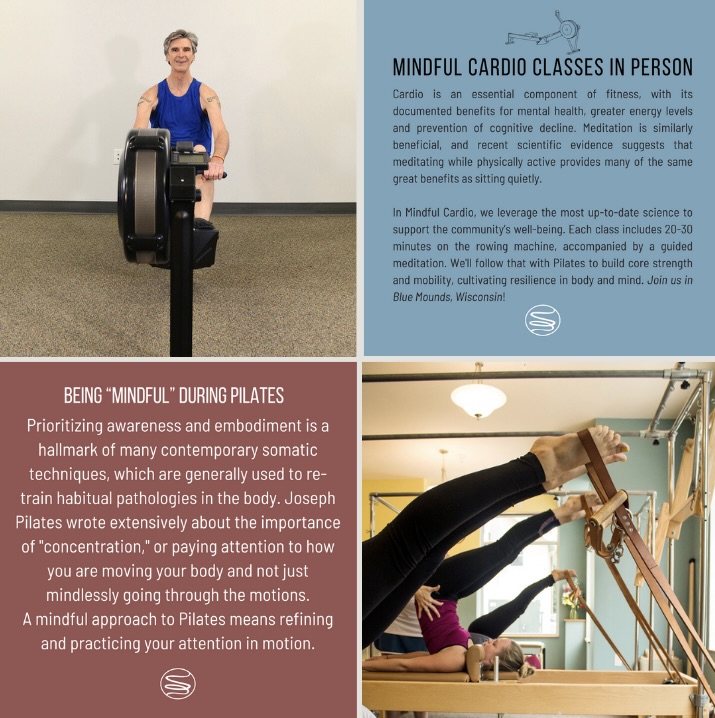
Both cardio and meditation are strongly associated with improving mental and physical wellbeing. Whether measuring the incidence and severity of diseases, indices of psychosocial wellbeing or inflammatory biomarkers, both cardio and meditation are disproportionately effective in cultivating wellbeing. During my recent pilgrimage, I spent many hours meditating while riding my bike. Since many of us are short on time, I strongly encourage you to practice meditation while doing cardio. The scientific evidence is increasingly indicating that active meditation confers the same benefits as formal meditation, and combining cardio and meditation has the potential to allow double-dipping in the time that you allocate to physical fitness. If you haven’t already tried my MDFL CARDIO classes, I encourage you to check them out via my studio's on-demand library . Interestingly, it appears as though cardio and meditation interact with different anti-inflammatory pathways. University of Wisconsi...

Whether you are training aerobic capacity, mobility or alignment, don't forget your muscles!

Image
Does your workout regimen include muscle building activities? It’s hard to overstate the importance of maintaining and building muscle mass. While strength, power and muscular endurance are all very important for optimal aging, your overall wellbeing is disproportionately related to your muscle mass. There are several factors that are influenced by muscle mass. Among them are: Muscle mass supports your joints . More muscle mass is generally associated with healthier joints. Your sense of balance is highly dependent on sensations that arise from your muscles. As you lose muscle mass, your balance tends to become shakier Bone density is influenced by muscle mass. When muscles pull harder on the bones, the osteoblasts in the bones respond by increasing bone density. More muscle = more force = greater bone density. Muscles are integrally involved in glucose metabolism ; building muscle is a powerful way to both treat and prevent insulin resistance. The academic article, linked below, des...

Aging & Inflammation

Image
Aging well is largely about managing inflammation. You will likely feel better and have more energy if your baseline levels of inflammation are lower, and will likely struggle more with aches, pains and low energy when your baseline levels of inflammation are higher. Managing inflammation is essential to aging well, and requires more than anti-inflammatory supplements and down time . Reducing baseline levels of inflammation requires the strategic application of inflammation. Known as hormesis , regular applications of inflammation can lower baseline levels of inflammation. To some small extent, that which doesn’t kill you may well make you stronger. The trick is getting the dose just right, as the dose of inflammation either makes the poison or the medicine. Yes, this is an eBike. I adjust the level of assist to maintain the just-right challenge. Exercise, particularly cardio, is inflammatory. This is among the many reasons why doing cardio is an essential element in aging well. In th...

Pilates and its Anti-Anxiety Effects

Image
I have found Pilates to be anxiolytic. While all exercise is great for managing the symptoms of anxiety and anxiety-related disorders, I’ve found that Pilates is particularly effective in doing so. As I built my Pilates teaching career, I did a deep dive into neuroscience and physiology as part of my doctoral work. In this graduate-level coursework, I learned more about the body/brain connection, and had a steady stream of lightbulb moments when I connected what I learned to Pilates. I’ve since come to view the physical benefits as a side-effect, with the main benefits of Pilates being mental. Along the way, I’ve identified five systems that are directly impacted by Pilates, and how these five systems downregulate an overactive nervous system and calm an anxious mind. Yes, Pilates is great for developing long, lean muscles. Many celebrities have embraced the practice, enjoying the aesthetically pleasing physique that arises surprisingly quickly. Joe Pilates is quoted as saying “Ten ses...

100,000 Miles on the Tesla

Image
I've been a car guy  my entire life. Toy cars were my childhood obsession. As a teenager, I somehow took obsessed  to the next level, and literally memorized tracts of my favorite auto repair manuals. (Yes, I had favorite repair manuals). I slightly downregulated these obsessions in my middle years, though I was still keenly aware of the cars around me, gimbaling to lock in on an unfamiliar model or automotive rarity. This Tesla Model Y has been on many roadtrips. When the Tesla Model S came out in 2012, I was swept off my feet by its aesthetics, performance and the underlying technology. Initially Tesla sightings were infrequent, and I employed the unproven technique of staring/not-staring in an inept attempt to avoid stalking the early adopters. Within a few years, however, the more-affordable Model 3 opened the sales flood gates, and it suddenly seemed like Teslas were everywhere. The "Idiot Book" was my favorite repair manual. By the time the Tesla Model Y (the small ...

30-years in the Driftless

Image
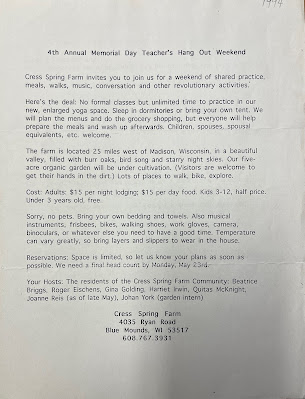
Thirty years ago I inadvertently landed in Wisconsin's Driftless Region. Lured by the call of Yoga, community and sustainable agriculture, I found a place that I have called home for the better part of my life. Over Memorial Day Weekend 1994, I made the somewhat impulsive decision to relocate to Blue Mounds, WI; a decision I have not regretted. I was drawn to the Driftless by the 1994 Memorial Day Teacher's Hang Out Weekend The Spring of 1994 was a pivotal time in my life. I'd recently graduated from college, and with a group of friends, co-founded the St. Paul Yoga Center . Despite the path that was unfolding, I felt an itchiness to explore and reevaluate my emerging adult life. I yearned to live closer to the land, and simultaneously felt that the Yoga I practiced and taught was detached from the natural world. The call of the 4th Annual Memorial Day Teacher's Hang Out Weekend could not have come at a more opportune time. It seems almost quaint, now, to receive an inv...

MDFL CARDIO Classes - For Mental and Physical Wellbeing

Image
 

More Protein Isn’t Necessarily Better For You

Image
More isn’t always better. Sometimes more is less and often less is more. In the case of protein, it seems as though there are many voices advocating for more, more, more. I find this deeply puzzling and concerning. To my knowledge, there are not any nutrients that continue conferring benefit beyond a certain threshold. Whether it’s excessive consumption of water (hyponatremia), some nutrients (vitamin toxicity) or sleeping too much (hypersomnia), anything that’s beneficial can ultimately inflect to become harmful. Protein is no exception. As I covered in a prior posting , active people who are working to build muscle thrive on about 1-gram of protein per kilogram of body mass. When people do the arithmetic (1 kilogram = 2.2 pounds), the majority find that they’re consuming significantly more protein than their body has any use for. And many people thrive with far less than 1-gram of protein per kilogram of body mass! This lunch supplied about 1/3 of my daily protein needs More isn’t al...

Quantifying Lean Mass

Image
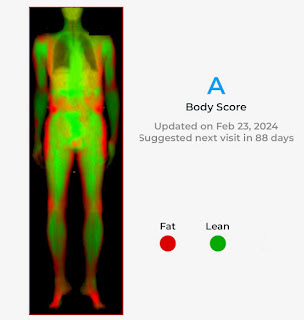
One of the first order treatments for osteoarthritis in the knees is weight loss . However, muscle mass also protects knees, so losing weight by losing muscle isn't the ticket in working with high-mileage knees. The trick in working with high-mileage knees is losing fat while maintaining or even building muscle. I've been thinking about this conundrum, and felt that I needed more information. As many of you know, I'm more than a little geeky, and I knew that dual-energy X-ray absorptiometry (DEXA) scans provide a high-resolution view of body composition. Unfortunately, my primary care doc only knew of DEXA scans as screens for bone loss, and was unaware of the many body-composition insights that can be provided by a whole body DEXA scan. To access the information only a DEXA scan can provide, I'd have to find a provider and pay for it out of pocket. Does this DEXA scan make my feet look fat? I consulted Professor Google, and found a nearby facility that offered what see...

Mitochondria - Small, Yet Mighty

Image
The mitochondria in your cells are small, yet mighty. You can almost think of them as cellular mighty-chondria in how they convert fat and carbohydrate into usable energy. The quantity and quality of cellular mitochondria directly impact your life, and lifestyle decisions directly impact the mightiness of your ‘chondria. Moderate-intensity cardio supports cellular health. In the previous blog posting, I discussed how sweet food, particularly sweet food that is not accompanied by fiber, impairs both the production and vitality of mitochondria. Fiber is good. Sweeteners, whether natural or artificial, caloric or non-caloric, are generally not-so-good. In whatever way that you can, increase your consumption of fiber to benefit your mitochondrial vitality. In working with mitochondria, another “lever” that can be pulled is physical activity. The human body is built to move, and any physical activity is generally better than sitting on the sofa. Cardio, in particular, is mightily beneficial...